

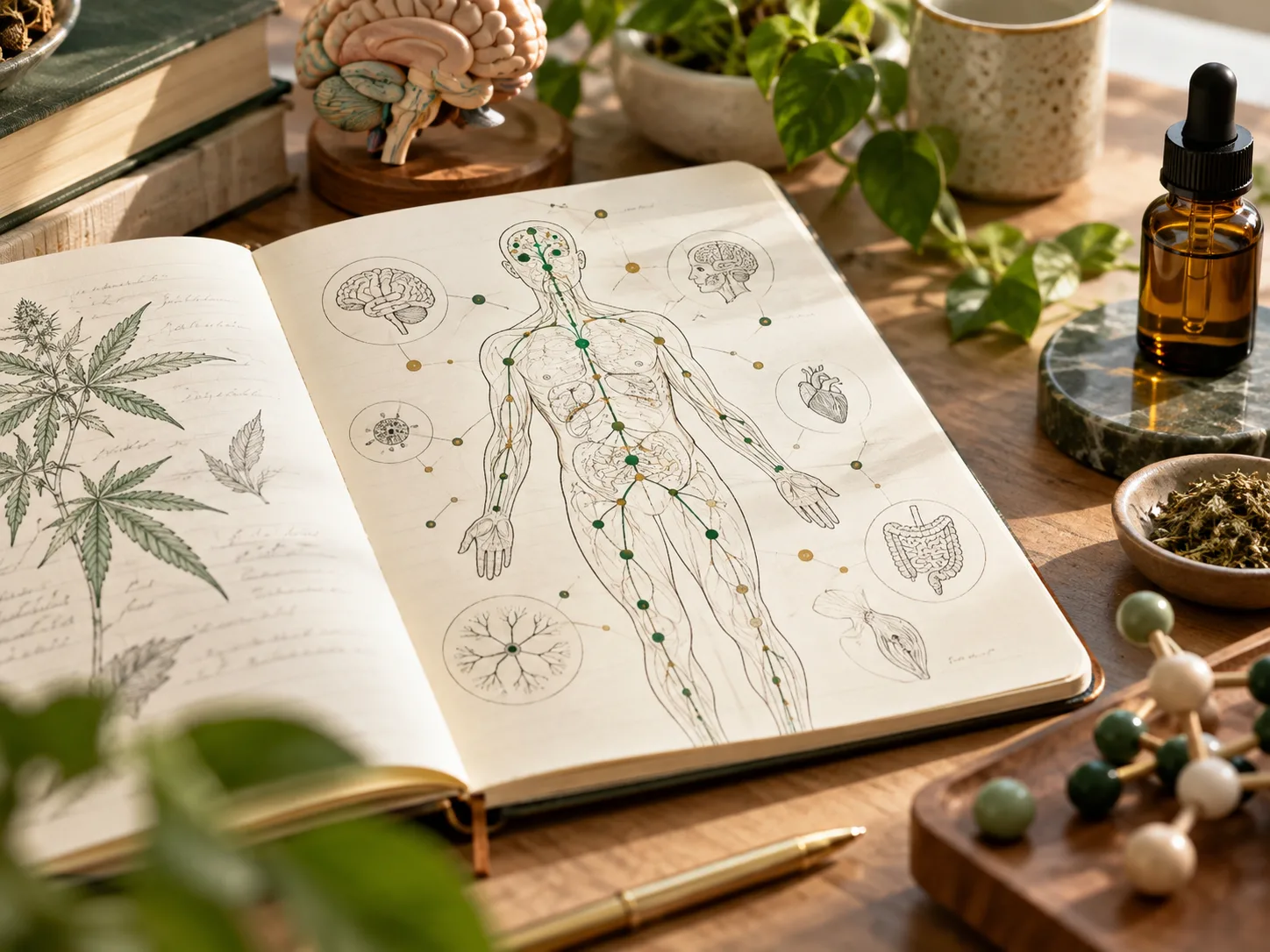
Your body was built to interact with cannabis. The human body contains a vast cellular communication network specifically designed to bind with cannabinoid compounds, and it was producing its own version of those compounds long before anyone ever grew a cannabis plant.
The endocannabinoid system, or ECS, is one of the largest receptor systems in the human body. It helps regulate mood, appetite, sleep, pain perception, immune response, memory, and more. And yet most people have never heard of it, including, until relatively recently, most doctors.
Understanding what the endocannabinoid system is and how it works doesn’t just satisfy curiosity. It explains why cannabis affects the body the way it does, and why different products and consumption methods produce such different experiences.
When Was the Endocannabinoid System Discovered?
The discovery of the ECS is surprisingly recent. Israeli researcher Dr. Raphael Mechoulam — the same scientist who isolated THC in 1964 — was central to its identification. In 1988, researchers at the St. Louis University School of Medicine discovered the first cannabinoid receptor in the brain, now called CB1. In 1992, Mechoulam and his team identified the first endogenous cannabinoid — a compound the body produces on its own and named it anandamide, from the Sanskrit word ananda, meaning bliss.
The full picture of the endocannabinoid system came into focus through the 1990s, as researchers identified a second receptor (CB2), a second major endocannabinoid (2-arachidonoylglycerol, or 2-AG), and the enzymes that synthesize and break these compounds down. The formal term “endocannabinoid system” wasn’t coined until 1995, which means this entire biological system, present in every vertebrate animal, went unidentified by medical science until about 30 years ago.
That recency helps explain why the ECS isn’t commonly taught in medical schools or discussed in routine clinical care, a gap Harvard Health has noted in its coverage of the topic. The science is real and growing; the clinical integration is still catching up.
The Three Parts of the Endocannabinoid System
Understanding what the endocannabinoid system is easier with a simple framework. The ECS has three core components: receptors, endocannabinoids, and enzymes. Each plays a distinct role, and together they function like a biological thermostat constantly monitoring conditions in the body and making adjustments to keep things in balance.
Receptors are the receivers. They’re embedded in cell membranes throughout the body and brain, waiting for the right molecule to arrive and activate them. Think of a receptor as a lock, and the molecule that fits it as a key. When the right key arrives, the lock opens, and a signal.
Endocannabinoids are the body’s self-produced keys — molecules synthesized on demand when the body needs to send a specific signal. The two primary endocannabinoids are anandamide and 2-AG. Anandamide is associated with mood regulation, motivation, and pain modulation. 2-AG is present at much higher concentrations in the body and appears to be involved in a wider range of functions, including immune response and neuroprotection.
Enzymes are the cleanup crew. Once an endocannabinoid has done its job and delivered its signal, enzymes break it down so it doesn’t keep signaling indefinitely. Fatty acid amide hydrolase (FAAH) breaks down anandamide. Monoacylglycerol acid lipase (MAGL) breaks down 2-AG. The efficiency of these enzymes affects how long endocannabinoids stay active in the system.
Together, these three components help maintain homeostasis, the body’s internal balance across temperature, mood, inflammation, hunger, sleep cycles, and dozens of other processes.
CB1 and CB2 Receptors: What’s the Difference?
The two primary receptor types in the endocannabinoid system have distinct locations and functions, and understanding both helps explain why cannabis can produce such a wide range of effects.
CB1 receptors are concentrated primarily in the central nervous system — the brain and spinal cord. They’re found in especially high densities in areas associated with memory formation (the hippocampus), motor control (the cerebellum and basal ganglia), pain processing (the periaqueductal gray), and reward and mood (the prefrontal cortex and limbic system). CB1 receptors are among the most abundant receptor types in the brain — a 2020 review in Frontiers in Cellular Neuroscience noted they’re expressed in nearly all brain regions.
CB2 receptors are found primarily in peripheral tissues and are heavily concentrated in immune system cells. They’re involved in inflammation regulation, immune response, and pain signaling outside the central nervous system. CB2 receptors are also present in the gut, liver, and bone tissue.
The different locations explain a lot about cannabis effects. THC binding primarily to CB1 receptors in the brain produces psychoactive effects, the cognitive and mood changes most people associate with cannabis. CBD’s more complex interaction pattern, which doesn’t involve direct binding to either receptor in the same way, produces different results. And compounds that act more on CB2 receptors may influence inflammation and immune function without producing a high at all.
What Is Anandamide and Why Does It Matter?
Anandamide was the first endocannabinoid identified, and it’s still one of the most important for understanding what the endocannabinoid system does in everyday terms. It binds primarily to CB1 receptors and plays a central role in mood regulation, motivation, appetite, and pain modulation.
Anandamide is sometimes called the “bliss molecule,” which undersells how functionally important it actually is. Research has linked lower anandamide levels to increased anxiety and stress reactivity. A 2015 study published in the NIH found that individuals with a gene variant that slows anandamide breakdown had lower anxiety levels and showed less reactivity to threat, suggesting that anandamide concentration in the brain measurably affects emotional regulation.
Anandamide also helps explain why the “runner’s high” is now understood differently than it was for decades. Exercise-induced euphoria was long attributed entirely to endorphins, but more recent research suggests anandamide plays a significant, possibly primary, role. Endorphins are too large to cross the blood-brain barrier efficiently; anandamide is not.
This matters for understanding cannabis because THC is structurally similar to anandamide. That structural resemblance is why THC binds to CB1 receptors so effectively; it’s using the same lock that anandamide was designed for, which is why the effects of THC feel familiar to the body in a way that, say, caffeine or alcohol don’t.
How Does THC Interact with the Endocannabinoid System?
THC (tetrahydrocannabinol) is a phytocannabinoid: a cannabinoid that comes from a plant rather than being produced by the body. Its psychoactive effects come directly from its relationship with the endocannabinoid system, specifically its affinity for CB1 receptors.
When THC enters the system, whether through inhalation, ingestion, or another route, it binds to CB1 receptors with high affinity, mimicking the action of anandamide but with some important differences. Anandamide is produced on demand, acts locally, and is broken down quickly by FAAH. THC, by contrast, isn’t broken down by FAAH at the same rate, so it stays active longer and produces more sustained effects than the body’s own endocannabinoids typically do.
The intensity and character of the experience depend on factors like dose, tolerance, the ratio of cannabinoids present, and the product’s terpene profile, which is exactly what the entourage effect describes. Terpenes interact with the same receptors and neurotransmitter systems that the ECS interfaces with, which is why whole-plant products often feel different from isolated THC.
The method of consumption also changes the ECS interaction significantly. Inhaled THC reaches CB1 receptors in the brain within minutes. Ingested THC is first converted by the liver into 11-hydroxy-THC before reaching those receptors, a metabolite that binds differently and produces a longer, often more intense effect.
How Does CBD Affect the Endocannabinoid System?
CBD (cannabidiol) interacts with the endocannabinoid system in a more indirect and complex way than THC, which is a large part of why it produces different effects.
CBD doesn’t bind strongly to CB1 or CB2 receptors the way THC does. Instead, it appears to modulate the ECS through several mechanisms: it inhibits FAAH, the enzyme that breaks down anandamide, which allows anandamide to stay active in the system longer. It also interacts with serotonin receptors (5-HT1A), TRPV1 receptors involved in pain signaling, and GPR55 receptors that may play a role in inflammation and bone density.
The net effect of these interactions is subtler and more diffuse than THC’s direct receptor binding. CBD doesn’t produce a high, but it does influence the same systems the ECS regulates, which is why research has examined its role in anxiety, inflammation, seizure activity, and sleep. The FDA-approved drug Epidiolex, a purified CBD extract used to treat certain rare seizure disorders, is the clearest clinical validation of CBD’s biological activity through these pathways.
When THC and CBD are present together, CBD appears to modulate some of THC’s effects, particularly the anxiety that high doses of THC can produce in some people. This is another dimension of the entourage effect and one reason why full-spectrum cannabis products, which preserve both cannabinoids alongside terpenes and minor cannabinoids, often produce more balanced experiences than THC isolate alone. A deeper look at what terpenes are and why they matter is worth reading alongside this post.
Does Everyone Have an Endocannabinoid System?
Every vertebrate animal has an endocannabinoid system: humans, dogs, cats, horses, fish, birds. The ECS appears to have evolved over 600 million years, making it one of the oldest and most conserved biological systems across the animal kingdom.
The short answer is yes, every person has an endocannabinoid system. What varies is how efficiently it functions.
A concept called clinical endocannabinoid deficiency (CECD), proposed by Mechoulam and expanded by researcher Ethan Russo, suggests that some individuals may naturally produce lower levels of endocannabinoids or have less responsive receptors.
Russo’s research, published in Neuro Endocrinology Letters, proposed that conditions like migraines, fibromyalgia, and irritable bowel syndrome may be associated with endocannabinoid deficiency — though this theory is still being investigated and hasn’t yet produced clinical treatment protocols.
Why Don’t Doctors Talk About the Endocannabinoid System?
It’s a fair question, and the answer is primarily historical. The ECS was formally identified only in the 1990s, so it wasn’t included in the medical training of most currently practicing physicians. Medical school curricula update slowly, and the ECS’s relatively recent discovery means it still hasn’t been fully integrated into standard education.
The research environment also matters. For decades, the federal classification of cannabis as a Schedule I substance in the United States created significant barriers to research, limiting funding, restricting access to study materials, and reducing the number of clinical trials that could be conducted. That environment produced a gap between what basic science has found about the ECS and what clinical medicine has been able to test and validate.
A 2013 survey by cardiologist Dr. David Allen found that only 13% of US medical schools included the endocannabinoid system (ECS) in their curricula. That’s beginning to change as legal markets expand and research barriers ease, but the gap remains and helps explain why many patients know more about the ECS than their doctors do.
Putting the ECS in Context
Understanding what the endocannabinoid system is changes how you think about cannabis not as a substance that hijacks your brain chemistry, but as one that interacts with a system your body already has and already depends on. THC works because it resembles anandamide. CBD works because it influences how the ECS regulates itself. Terpenes work because they interface with many of the same receptors and neurotransmitter systems the ECS connects to.
This is also why product choices matter more than they might seem at first. The cannabinoid ratios, terpene profiles, and consumption methods you choose affect how phytocannabinoids interact with your ECS and, therefore, what you actually experience.
At Garden Club, staff are trained to talk through exactly this kind of question and match products to what you’re looking for, whether that’s the full science or a practical recommendation. For a deeper look at the specific compounds involved, the Garden Club cannabis glossary and the post on what THC is and how it works both build directly on the foundation here.
