

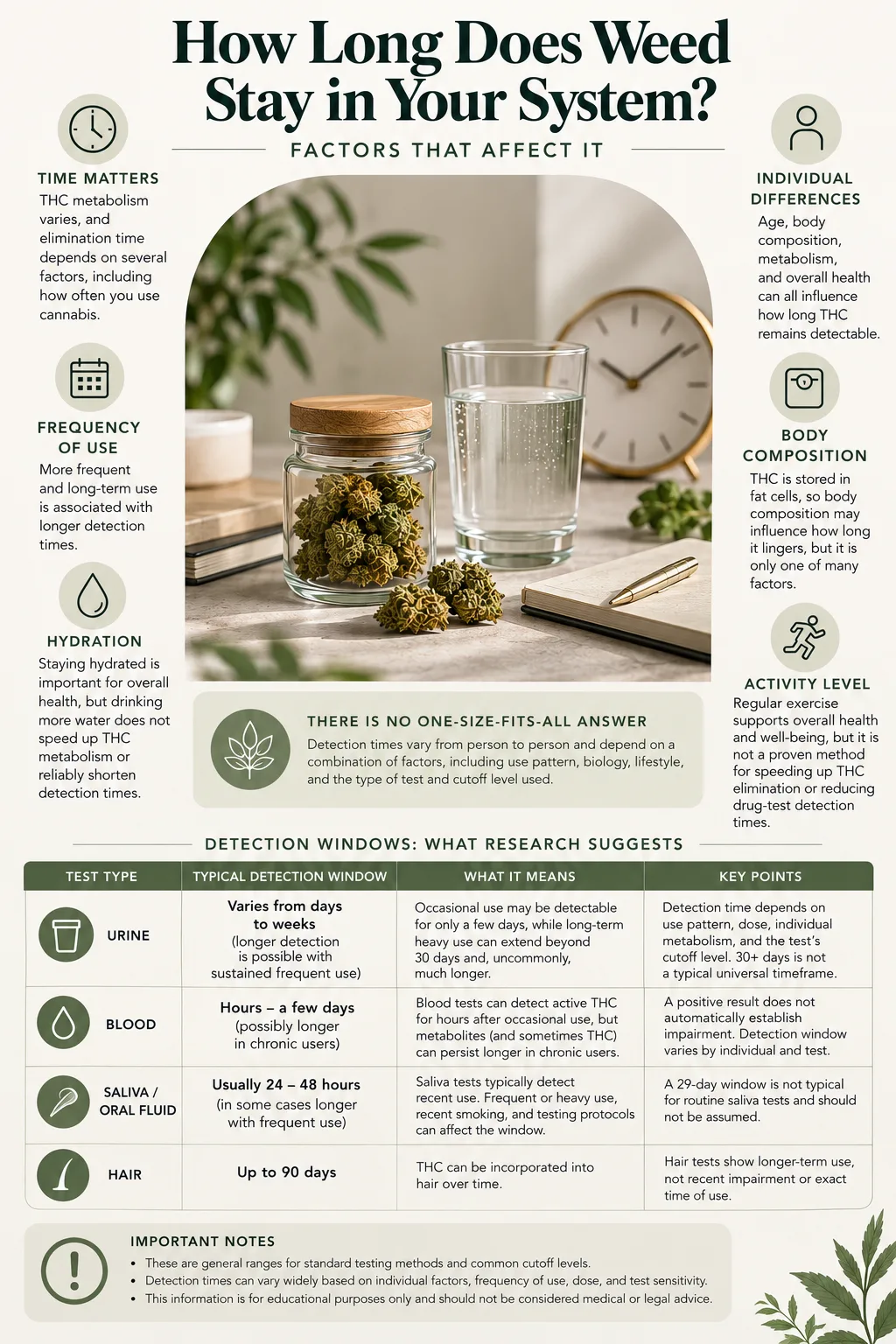
If you used cannabis recently and have a drug test coming up, there is no single number that can tell you whether you will test positive. Detection depends most on the kind of test, how often and how much cannabis you use, the time since your last use, and the laboratory’s cutoff level.
The most important distinction is this: a cannabis test usually measures evidence of prior exposure—not whether you are currently high or impaired. Urine testing commonly detects the inactive metabolite THC-COOH, while blood and oral-fluid tests more often measure THC itself. Even then, a positive THC result does not reliably establish a particular degree of impairment; the National Institute of Justice’s review of THC testing and field sobriety research explains why cannabis does not have a blood-test equivalent to alcohol’s BAC standard.
Important: This article is general education, not medical, legal, employment, probation, or driving advice. Laboratories, employers, courts, treatment programs, and jurisdictions use different rules, cutoffs, and procedures. Do not use a detection-window estimate to decide whether it is safe or lawful to drive or perform safety-sensitive work.
Why Cannabis Can Be Detectable for a While
Delta-9 THC is cannabis’s primary intoxicating compound. It is lipophilic, meaning it dissolves more readily in fat than in water. After use, the body metabolizes THC into several compounds, including THC-COOH, an inactive metabolite commonly measured in urine testing.
With repeated use, cannabis-related compounds can remain measurable for longer because elimination is gradual. A controlled abstinence study of chronic cannabis users documented extended urinary cannabinoid excretion, including measurable cannabinoids for at least 24 days in some participants.
That does not mean body fat can predict a personal test date. Frequency and duration of use, total THC exposure, time since last use, the specimen being tested, and the laboratory cutoff are generally more useful than trying to estimate results from BMI or a self-described “fast metabolism.”
Detection Windows by Test Type
These are broad population estimates, not guarantees. A lower laboratory cutoff or a more sensitive confirmation method may lengthen the period during which a test can detect cannabis-related compounds.
| Test type | What it commonly measures | General detection window | What it can and cannot tell you |
| Urine | Usually THC-COOH, an inactive THC metabolite | One-time/infrequent use: often a few days; repeated use: days to weeks; sustained heavy use: 30+ days is possible | Most common test type. A positive result usually indicates prior exposure, not present impairment. |
| Blood | THC; some methods also measure metabolites | Often hours after occasional use; potentially longer with frequent or chronic use | More relevant to recent exposure than urine, but a positive result does not reliably establish impairment. |
| Saliva / oral fluid | Usually THC | Commonly hours to about 24–48 hours; occasionally longer depending on cutoff, route, and use pattern | Often intended to identify comparatively recent use. Smoking or vaping can leave THC residue in the mouth shortly after use. |
| Hair | Cannabis-related analytes incorporated into growing hair | Often reflects roughly the previous 90 days when a standard 1.5-inch segment is tested | Indicates possible historic exposure over a broad period. It cannot reliably identify the exact date of use or current impairment. |
| Fat tissue | Not a routine testing specimen | Not applicable | THC-related compounds can be stored in fat, but drug tests do not test “fat cells,” and fat storage cannot predict a personal testing timeline. |
For context, a controlled study by cannabis toxicologist Marilyn Huestis and colleagues found that, at a 50 ng/mL urine-screen cutoff, average detection after a single controlled exposure was less than one day at a lower dose and less than two days at a higher dose. Real-world detection can be longer because dose, prior use, test method, and cutoff vary.
How Long Cannabis Stays in Urine
Urine testing is common in workplace, pre-employment, treatment, and monitoring programs. It generally does not measure active THC. Instead, it commonly detects THC-COOH, a non-intoxicating metabolite that remains after cannabis’s noticeable effects have ended.
The following are useful broad expectations:
- One-time or infrequent use: Many people are negative within a few days on a standard urine screen. Results can last longer if the dose was larger, the test uses a lower cutoff, or cannabis use was not actually isolated.
- Repeated use: Detection can last from several days into one or more weeks.
- Daily or sustained heavy use: Detection can last several weeks, and 30+ days is possible. The controlled study of chronic users during abstinence is a useful reminder that there is no universal “30-day rule.”
A positive urine test does not show that someone is currently impaired. It only indicates that the concentration measured in the specimen exceeded that test’s reporting threshold.
What About Edibles?
Edibles and inhaled cannabis move through the body differently. Oral THC passes through the liver before entering broader circulation, producing more 11-hydroxy-THC than inhaled cannabis. But no reliable rule shows that edibles add a specific number of days to a urine-detection window.
The factors that matter most are the actual THC dose, product potency, frequency of use, time since use, and the laboratory’s cutoff—not simply whether the product was smoked, vaped, or eaten.
Blood, Saliva, and Hair Testing
Blood Testing
Blood tests may measure active THC and, depending on the laboratory method, THC metabolites. After occasional use, active THC is usually most detectable in the hours after use. More prolonged detection can occur among frequent users or with more sensitive testing methods.
Blood testing is often discussed in roadside and forensic settings, though it can also be used in clinical and post-incident contexts. The key limitation is that, unlike alcohol, there is no universally valid THC blood concentration that proves a specific level of impairment. The American Bar Association’s overview of cannabis-testing challenges and the National Institute of Justice review both emphasize that a THC result alone is not a dependable measure of impairment.
Saliva or Oral-Fluid Testing
Oral-fluid tests generally target THC and are most useful for identifying recent exposure. The typical detection period is often measured in hours to roughly one or two days. However, the exact window can vary based on the test cutoff, collection process, product type, and use pattern.
A controlled study of smoked cannabis and oral-fluid testing found that detection windows depended strongly on the chosen cutoff; at common thresholds, frequent smokers were detectable for roughly 26–30 hours in that study. Labcorp’s oral-fluid drug-testing guidance likewise describes oral-fluid detection in the approximate 5- to 48-hour range.
Smoking or vaping can result in an immediate oral-fluid positive because THC residue remains in the mouth. Edibles do not create the same smoke-related oral residue, though THC can still reach oral fluid through the bloodstream.
A 29-day saliva-testing window should not be presented as a standard expectation. Oral-fluid tests are generally not designed as “weeks later” cannabis tests.
Hair Testing
Hair testing can often look back around 90 days because many laboratories analyze the approximately 1.5 inches of hair closest to the scalp. Compounds may be incorporated into hair as it grows, creating a broad historical record rather than a real-time measure of use.
A research review examining cannabinoid concentrations in hair illustrates why hair testing depends heavily on laboratory cutoffs and analytical methods.
Hair-test results have important limits:
- A hair test cannot reliably pinpoint the exact day cannabis was used.
- It cannot establish current intoxication or impairment.
- Isolated cannabis use is less likely to be detected than repeated use.
- Hair characteristics, cosmetic treatments, sample collection, cutoffs, and laboratory procedures can affect results.
- Reputable laboratories use decontamination and confirmation procedures to reduce the chance that external smoke exposure alone drives a result.
Factors That Affect Detection Time
The main influences on cannabis-test results are the underlying exposure and the test itself—not detox products.
- Frequency and duration of use: Repeated or sustained use generally produces a longer detection window than a truly isolated exposure.
- Total THC dose: Higher doses, more potent products, concentrates, or multiple use sessions can produce a larger metabolite load.
- Time since last use: More time generally lowers concentrations, but it cannot be converted into a guaranteed negative result.
- Test type and cutoff: Urine, blood, oral fluid, and hair measure different analytes over different time periods. Lower cutoffs can detect smaller concentrations for longer.
- Route of use: Smoking, vaping, edibles, tinctures, and concentrates differ in absorption and metabolism. Smoking and vaping can create immediate oral-fluid detection through mouth residue.
- Individual variation: Metabolism, body composition, hydration status, health conditions, and other factors can contribute to variation. None can reliably predict a personal clearance date by itself.
THC’s fat solubility means body composition may contribute to testing differences, but it is not accurate to claim that body-fat percentage is the single best biological predictor or that BMI can tell a person when they will test negative.
Does Drinking Water Help?
Water does not speed THC metabolism or remove THC-COOH from fat tissue. Drinking excessive water may temporarily lower the measured concentration in urine by diluting the sample, but that is not the same as eliminating cannabis-related compounds.
Many testing programs evaluate specimen validity using urine creatinine and specific gravity. A review of urine specimen-validity testing describes a dilute specimen as one with creatinine of at least 2 mg/dL but below 20 mg/dL, combined with low specific gravity.
A dilute result may be reported or handled differently depending on the testing program. It may trigger a recollection, be reported as negative-dilute, or be addressed under an employer’s, court’s, or agency’s specific policy. Aggressive water loading is not a reliable strategy and can create complications without changing the body’s actual elimination rate.
Does Exercise Help Clear THC?
Exercise is beneficial for overall health, but it is not a proven way to shorten cannabis detection times.
In a human study of exercise and THC release, researchers found that 35 minutes of moderate exercise caused a small but statistically significant increase in circulating THC among regular cannabis users. A related study on fat-stored THC release found evidence consistent with THC release during lipolysis.
In practical terms, exercise should not be treated as a detox method or a way to produce a negative near-term drug test. Strenuous activity or fasting may temporarily alter measured cannabinoid concentrations in some regular users.
In the End…
A person who used cannabis once after months or years without use may have a relatively short urine-detection period—often a few days rather than weeks. Someone who has used daily or heavily over a sustained period may remain urine-positive for weeks and sometimes longer. Blood and oral-fluid tests usually focus more on recent exposure, while hair testing can reflect a longer period of prior exposure.
The only dependable way to reduce the chance of a cannabis-positive result is not to use cannabis and to allow time. No detox drink, supplement, sauna, exercise routine, or water-loading plan can reliably guarantee a negative test result.
