

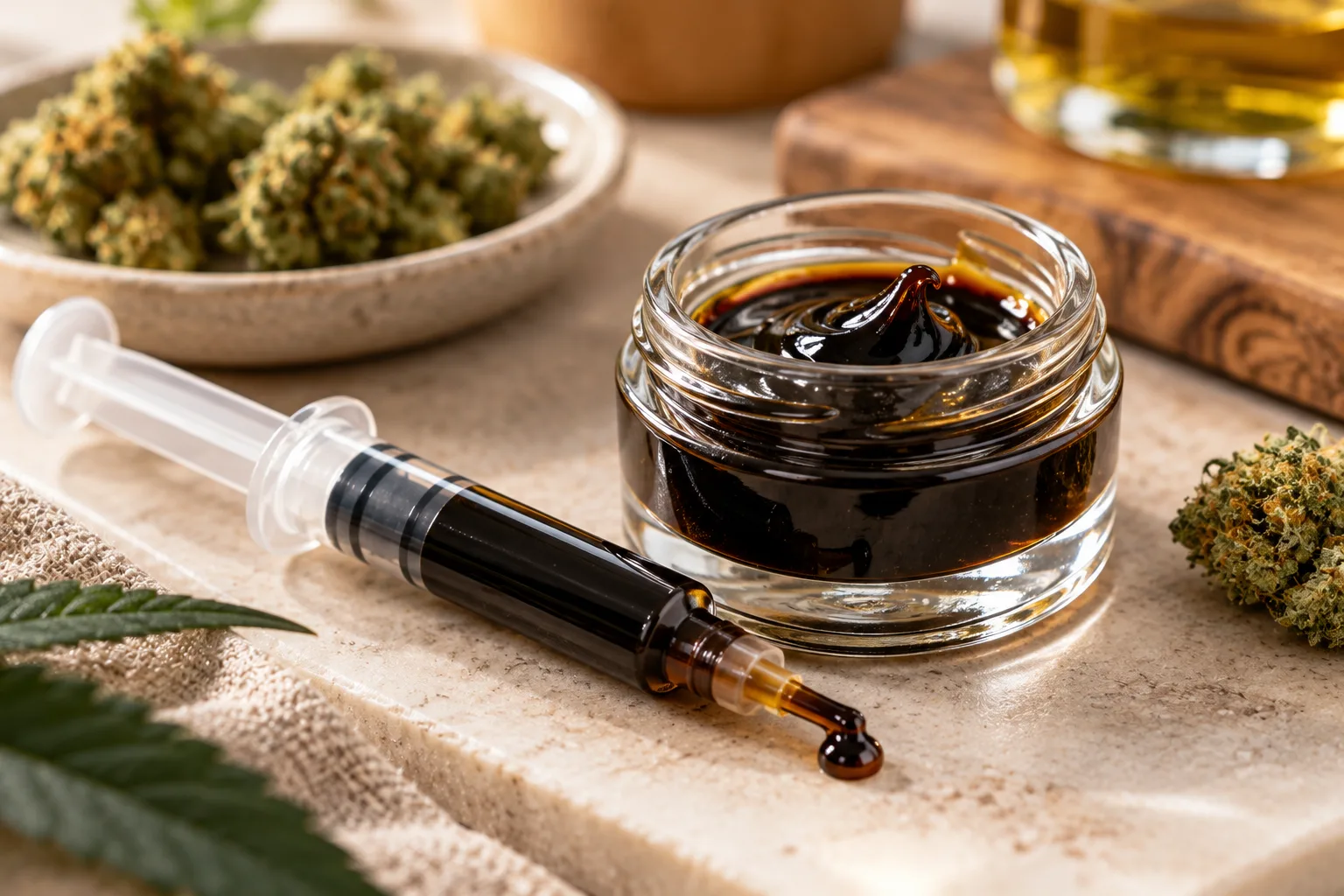
If you’ve spotted a dark, syrupy oil in a syringe on the dispensary shelf and wondered what it is, you’re not alone. RSO is one of the most potent cannabis products available in legal markets and one of the least understood. It looks different from everything else, it’s dosed differently, and the story behind it is unlike any other cannabis product.
RSO stands for Rick Simpson Oil, named after a Canadian cannabis activist who developed the preparation in the early 2000s. It’s a highly concentrated, whole-plant cannabis extract made using an ethanol-based process that pulls the full spectrum of cannabinoids, terpenes, and other compounds from the plant. The result is a thick, dark, tar-like oil that typically tests between 60–90% THC, making it among the most potent ingestible cannabis products on the market. Understanding what RSO is, how it’s made, and how it differs from other extracts helps explain why it occupies its own distinct category.
Who Is Rick Simpson and Where Did RSO Come From?
Rick Simpson is a Canadian engineer and cannabis advocate who began producing his own cannabis oil after being diagnosed with basal cell carcinoma (a form of skin cancer) in 2003. Simpson applied a concentrated cannabis oil topically to his skin lesions and reported that they resolved within days. He subsequently began producing and distributing the oil for free to people in his community, documenting his process and outcomes on his own website.
Simpson was never a licensed producer or medical professional, and his claims were never validated his claims. Canadian authorities raided him, and he faced legal challenges for years. But his open-source documentation of the preparation method circulated widely online, and the name “Rick Simpson Oil” became the dominant term for highly concentrated, ethanol-extracted, whole-plant cannabis oil regardless of who made it or where it came from.
The origin story matters because it shaped how RSO is perceived. It arrived in cannabis culture as a grassroots medical preparation, not as a recreational product. That framing still influences how most people seek it out today: primarily for wellness applications, high-dose use, or as an option when other cannabis formats haven’t provided what they were looking for.
How Is RSO Made?
RSO is produced through ethanol extraction, a process that uses food-grade alcohol as a solvent to strip cannabinoids, terpenes, chlorophyll, waxes, and other plant compounds from the cannabis material. The plant matter is soaked in ethanol, agitated, and then filtered to remove the solid material. The remaining alcohol-cannabinoid solution is then gently heated to evaporate the ethanol, leaving behind a concentrated, dark oil.
The key characteristic of RSO production is that it’s a whole-plant extraction. Nothing is removed or refined after the initial extraction: no winterization to strip plant waxes, no distillation to isolate specific cannabinoids, no color remediation to clarify the oil. What goes in comes out in concentrated form, which is why RSO is dark (chlorophyll and plant pigments remain in the oil) and why it has a distinctive earthy, pungent flavor that’s quite different from the cleaner taste of distillate.
The plant material used is also typically decarboxylated before or during extraction, meaning it’s been heated to convert THCA into active THC. This is what makes RSO potent as an oral product; without decarboxylation, the THC precursor would remain largely inactive when ingested. The result is a fully activated, highly concentrated, whole-plant oil ready for oral, sublingual, or topical use.
What Is RSO Used For?
RSO is most commonly used orally or sublingually, though some people apply it topically. Because it’s a whole-plant extract with high THC content, a very small amount goes a long way. Standard dosing guidance for RSO typically starts at a rice-grain-sized amount — roughly 25–50mg — taken orally, with gradual increases over time based on tolerance and response.
The oral route produces effects similar to other edible cannabis products: slower onset (30 minutes to 2 hours), longer duration (4 to 8 hours or more), and often a more intense experience than inhaled cannabis at equivalent THC doses. That’s because the liver converts ingested THC into 11-hydroxy-THC before reaching the brain, a more potent metabolite with a longer half-life. At RSO’s typical concentrations, dosing precision matters more than with any other ingestible format.
Some people use RSO sublingually, holding a small amount under the tongue for several minutes before swallowing. Sublingual absorption partially bypasses the digestive tract, allowing some cannabinoids to enter the bloodstream through the mucous membranes more quickly than full digestion. The effect typically starts faster than swallowing RSO directly.
Topical application is also practiced, typically for localized use on the skin. Topically applied cannabis doesn’t produce systemic psychoactive effects because cannabinoids applied to the skin don’t penetrate deeply enough to reach the bloodstream in meaningful concentrations.
People seeking RSO at the dispensary often fall into a few distinct groups: experienced cannabis consumers with high tolerance looking for the most potent oral option available, medical-minded consumers who specifically want a whole-plant preparation, caregivers researching options for family members, and consumers who’ve read about Rick Simpson’s original story and want to try the same type of product.
Does RSO Get You High?
Yes, significantly so, especially for consumers without a high THC tolerance. RSO is one of the strongest cannabis products available, and its potency combined with the nature of oral ingestion means the experience can be intense and long-lasting.
A product testing at 70% THC in a syringe format is not like taking a 10mg edible. A rice-grain-sized dose can contain anywhere from 25–75mg of THC depending on the product’s potency and how much oil is dispensed. For reference, the standard “beginner” edible dose is 2.5–5mg, and 10mg is considered a moderate dose for most adult consumers. RSO doses at the low end of its typical range can be 5 to 10 times that.
That is why RSO isn’t usually positioned as a recreational or casual-use product. It’s something most consumers approach intentionally, often with a specific purpose in mind, and with an understanding of the commitment involved. A first-time RSO user without meaningful cannabis tolerance could have an unexpectedly intense experience from a quantity that looks negligibly small.
RSO vs FECO vs Distillate vs Tincture: What’s the Difference?
RSO appears on the same dispensary shelf as several other concentrated cannabis products, and it’s easy to confuse them. Here’s how they compare:
| RSO | FECO | Distillate | Tincture | |
| Extraction method | Ethanol, whole-plant | Ethanol, whole-plant | Distillation (refined) | Ethanol or CO2 (diluted) |
| Plant compounds retained | Full spectrum | Full spectrum | Primarily THC/CBD | Varies |
| Appearance | Dark, tar-like | Dark, tar-like | Clear/amber, viscous | Liquid, lighter color |
| THC range | 60–90% | 60–90% | 85–99% | 5–30% |
| Delivery format | Syringe | Syringe or jar | Syringe, cartridge, capsule | Dropper bottle |
| Flavor | Strong, earthy | Similar to RSO | Neutral to mild | Mild to moderate |
| Entourage effect | Yes | Yes | Limited | Varies |
RSO vs FECO: FECO stands for Full Extract Cannabis Oil, and it’s essentially the same thing as RSO — a whole-plant ethanol extraction. The terms are often used interchangeably, though some producers use “FECO” to distinguish their product from Rick Simpson’s branding. In practice, if you see both on a dispensary menu, read the lab results and extraction method rather than relying on the name.
RSO vs distillate: Distillate is a refined extract, processed at high temperatures to isolate specific cannabinoids — typically THC or CBD — from everything else. It’s clear or amber in color, nearly odorless, and tests very high in its target cannabinoid (often 85–99% THC). What distillate lacks is the full spectrum of minor cannabinoids, terpenes, and plant compounds that RSO retains. The tradeoff is potency vs whole-plant complexity. RSO delivers the entourage effect that distillate largely doesn’t.
RSO vs tincture: A tincture is a diluted cannabis extract, the same base oil or ethanol extraction, but suspended in a carrier oil or additional alcohol to produce a product with a much lower THC concentration per drop. Tinctures are designed for precise, accessible micro-dosing. RSO is the opposite: maximally concentrated, not diluted, designed for high-dose use. They’re related products at very different ends of the concentration spectrum.
Why Does RSO Come in a Syringe?
The syringe format is practical, not clinical. RSO is too thick and viscous to be dispensed accurately from a dropper bottle. The oil doesn’t flow freely enough at room temperature. A syringe allows controlled, measured dispensing of a product where small dose differences can produce noticeably different effects.
The syringe also protects the oil from air exposure, which can degrade THC and terpenes over time. Keeping RSO sealed until use and refrigerating it between uses extends its shelf life and preserves its potency.
One practical note: RSO thickens considerably when cold and becomes more fluid at room temperature. If you’re having difficulty dispensing from a syringe, warming it briefly in your hands or running the sealed syringe under warm water for a few seconds makes the oil flow more easily without damaging the product.
Is There Research on RSO?
This is where honesty matters most. The clinical research base for RSO specifically is thin. Rick Simpson’s original claims were based on his personal experience and anecdotal reports from people he shared the oil with, not controlled studies. No large-scale, peer-reviewed clinical trials specifically study RSO as a preparation.
What does exist is a growing body of research on cannabis extracts, cannabinoids, and their interactions with various health conditions. This research provides a scientific basis for understanding why people seek out RSO, even if it doesn’t validate specific therapeutic claims. Studies have examined cannabinoids in the context of nausea and appetite stimulation (particularly relevant for cancer patients undergoing chemotherapy), pain, sleep, and anxiety. The National Cancer Institute acknowledges cannabis as having demonstrated anti-tumor activity in preclinical (cell and animal) models, while noting that clinical evidence in humans remains insufficient to support treatment recommendations.
The gap between preclinical findings and clinical validation is real, and it drives most of the controversy around RSO. Consumers should approach the product knowing that the science is genuinely evolving, that individual responses vary significantly, and RSO is not a replacement for medical care or professionally supervised treatment.
What to Expect When You Try RSO
If you decide RSO is what you’re looking for, a few practical expectations can help you get started.
Start smaller than you think you need to. A rice-grain-sized amount is the standard starting point for good reason: it’s genuinely easy to overdo it with RSO, and the effects of an oral dose can take up to two hours to fully develop. Consuming more before the first dose has fully taken effect is the most common RSO mistake.
The flavor is strong and distinctly plant-forward. Unlike distillate, which has been refined to near-neutrality, RSO tastes like concentrated cannabis — earthy, slightly bitter, with a richness that reflects the full spectrum of compounds present. Some people mix it into food or capsules to manage the flavor; others take it straight and follow with something to eat.
Effects from oral RSO are long-lasting. Plan for a 4- to 8-hour window, potentially longer at higher doses. RSO isn’t a product for a quick session; it’s a commitment, and it’s best approached on a day when you have nowhere you need to be and nothing that requires precise cognitive function.
At Garden Club, the staff can walk you through the specific RSO products currently available, including their potency specs and extraction method, so you know exactly what you’re working with before you leave the store.
