
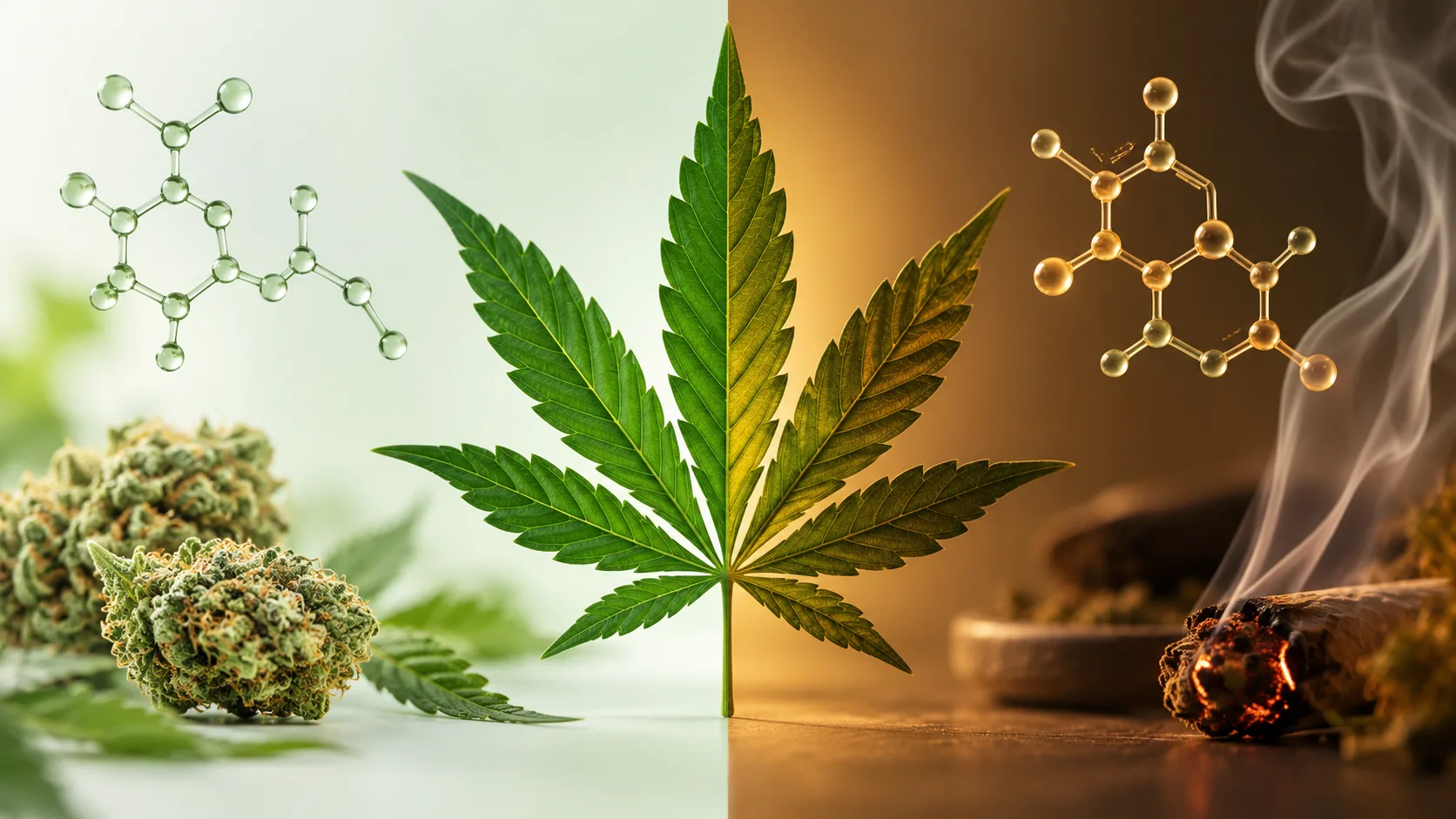
Most people have stared at a cannabis label and seen two numbers sitting side by side — THC and THCA — and assumed they meant roughly the same thing. They don’t. And if you’ve ever wondered why a flower with 25% THCA hits so differently than an edible listing 10mg THC, that confusion is exactly what this article breaks down.
These two compounds are chemically related but functionally distinct, and understanding the difference between THC vs THCA can genuinely change how you read a label, choose a product, and think about your experience.
What Is THCA?
THCA stands for tetrahydrocannabinolic acid. It’s the raw, unactivated form of THC that exists naturally in a living cannabis plant. Every cannabinoid starts as an acid, and THCA is the precursor to the THC most people are familiar with.
Here’s the key thing to understand: THCA is not psychoactive. When you look at a fresh cannabis flower with 28% THCA on the label, that compound hasn’t become THC yet. The plant produces THCA through its natural biosynthesis process, and it stays in that acidic form unless it’s exposed to heat.
That’s a meaningful distinction, especially for people exploring raw cannabis for wellness reasons, or for anyone reviewing lab results and trying to gauge actual potency.
What Is THC?
THC — delta-9-tetrahydrocannabinol — is the compound responsible for the psychoactive effects cannabis is known for. It binds to CB1 receptors in the brain and central nervous system, producing the “high” that most adult-use consumers are after.
THC is what you’re actually consuming when you smoke, vape, or eat an infused product. But it almost never starts as THC. It starts as THCA, and it becomes THC through a process called decarboxylation.
THCA Decarboxylation: How the Conversion Happens
Decarboxylation is just a scientific word for “applying heat.” When THCA is exposed to a high enough temperature, a carboxyl group (the “A” part of the acid) is released as carbon dioxide, and what remains is active THC.
This happens in a few ways:
Smoking or vaping: The instant the flame or heating element reaches the flower, THCA converts to THC. It’s fast and nearly complete, which is why smoked flower delivers effects quickly.
Baking or cooking: Infused products undergo decarboxylation in an oven, typically at 220–245°F for 30–45 minutes. This is why raw cannabis mixed into a salad wouldn’t get you high, but a properly made brownie would.
Sun exposure: THCA converts slowly to THC with prolonged UV exposure, though this isn’t a reliable or efficient method.
The important takeaway here is that THCA and THC are the same compound at different stages. Decarboxylation is just the activation step.
Does THCA Get You High?
On its own, in its raw form, no — THCA does not get you high. It doesn’t bind effectively to CB1 receptors the way THC does, which means consuming raw THCA won’t produce psychoactive effects.
But the moment you apply heat — lighting a bowl, hitting a vape, or eating a decarboxylated edible — the THCA you started with has already become THC. So by the time you’re actually consuming the product, the conversion has happened.
THC vs THCA Potency: Reading Labels the Right Way
This is where the practical difference between THC vs THCA matters most for shoppers.
When you pick up flower atGarden Club, the THCA percentage on the label is the primary potency indicator for smoked or vaped products. Because smoking triggers decarboxylation, nearly all of that THCA converts to THC during use.
Lab results typically apply a conversion formula: Total THC = (THCA × 0.877) + THC. The 0.877 factor accounts for the molecular weight lost when the carboxyl group is released. So a flower showing 25% THCA and 1% THC would calculate to roughly 22.9% total active THC after smoking.
A product with 25% THCA is not the same as one with 25% THC. THCA is the non-intoxicating precursor, while THC is the active cannabinoid already present in the flower; heating converts more THCA into THC
What Happens When You Smoke THCA?
When you smoke or vape high‑THCA flower, the heat converts most of the THCA into delta‑9 THC in real time through decarboxylation. Because of that conversion, the experience is functionally similar to smoking high‑THC flower, but it’s not perfectly 100% instantaneous or complete—some THCA may remain unconverted, and excessive heat can degrade THC.
How to Interpret Labels
A flower labeled 30% THCA is not the same as one labeled 30% THC. To estimate total potential THC, labs and regulators commonly use the formula:
Total THC=(THCA×0.877)+measured THC
The 0.877 factor accounts for the molecular weight lost when CO₂ is released. So a flower with 25% THCA and 1% measured THC has a total potential THC of about 22.9% after decarboxylation. Actual delivered THC can be lower due to incomplete conversion and losses during combustion or inhalation.
For edibles, producers typically decarboxylate the material before making the product, so THC is already present in the final edible. For flower and vape products, the conversion happens at the moment of use when heat is applied.
Why “THCA Flower” Exists in Some Markets
“THCA flower” refers to cannabis flower with high THCA content but low measured delta‑9 THC on its lab report. Because some laws limit measured delta‑9 THC (not THCA), this can allow high‑potency flower to be legally categorized differently in certain markets. Once you smoke or vape it, the THCA converts to delta‑9 THC, and you get the psychoactive effects.
THCA Benefits: What the Research Suggests
Because THCA doesn’t bind to the same receptors as THC, researchers have been exploring its own distinct potential. Current early research — most of it in preclinical stages — suggests THCA may have anti-inflammatory, neuroprotective, and anti-nausea properties.
A 2017 study published in the British Journal of Pharmacology found that THCA demonstrated neuroprotective effects in animal models, sparking interest in its potential for conditions such as Parkinson’s and Huntington’s disease. It’s worth noting that this research is at an early stage and hasn’t yet translated to clinical trials or treatment guidelines.
For consumers interested in raw cannabis — juicing fresh leaves, using cold-process tinctures, or blending raw flower into smoothies — THCA is the compound they’re primarily working with. These methods intentionally avoid heat to keep the THCA intact and non-psychoactive, which is a different use case entirely from smoking or vaping.
Does THCA Show Up on a Drug Test?
This is a common question, and the answer is: it can. Standard drug tests screen for THC metabolites, specifically THC-COOH. When THCA converts to THC in your body (whether through digestion or inhalation), your system metabolizes it the same way.
Even raw THCA can partially convert to THC through stomach acid, which means consuming raw cannabis isn’t a guaranteed way to avoid a positive test result. If you’re subject to drug screening, it’s worth knowing that the distinction between THCA and THC is largely irrelevant from a testing standpoint.
Is THCA Legal?
THCA’s legal status depends entirely on context and jurisdiction. In states where adult-use cannabis is legal — like Ohio — THCA in licensed cannabis products is legal to purchase and possess according to state law.
The situation gets more nuanced in the hemp market. Because hemp is federally legal when it contains less than 0.3% delta-9 THC by dry weight, some producers have marketed high-THCA hemp flower as a legal alternative in states without adult-use programs. The legal standing of these products is contested and varies by state.
If you’re in Ohio, visiting Garden Club’s Ohio locations means you’re buying state-licensed cannabis products that meet all regulatory standards — no ambiguity about what you’re getting or where it comes from.
Putting It All Together
The relationship between THC vs THCA is really about timing. THCA is what the plant makes. THC is what you activate. For smokers and vapers, the THCA percentage is the number to focus on — it’s your real-world potency indicator. For people interested in raw cannabis and non-psychoactive use, THCA has its own emerging profile of potential benefits that doesn’t require any activation at all.
Reading labels well is one of the simplest ways to make smarter choices at the dispensary. Knowing that THCA × 0.877 gets you close to your actual THC yield, or that a cold-process product maintains THCA in its raw form, puts you in a genuinely better position than just scanning for the biggest number on the package.
