

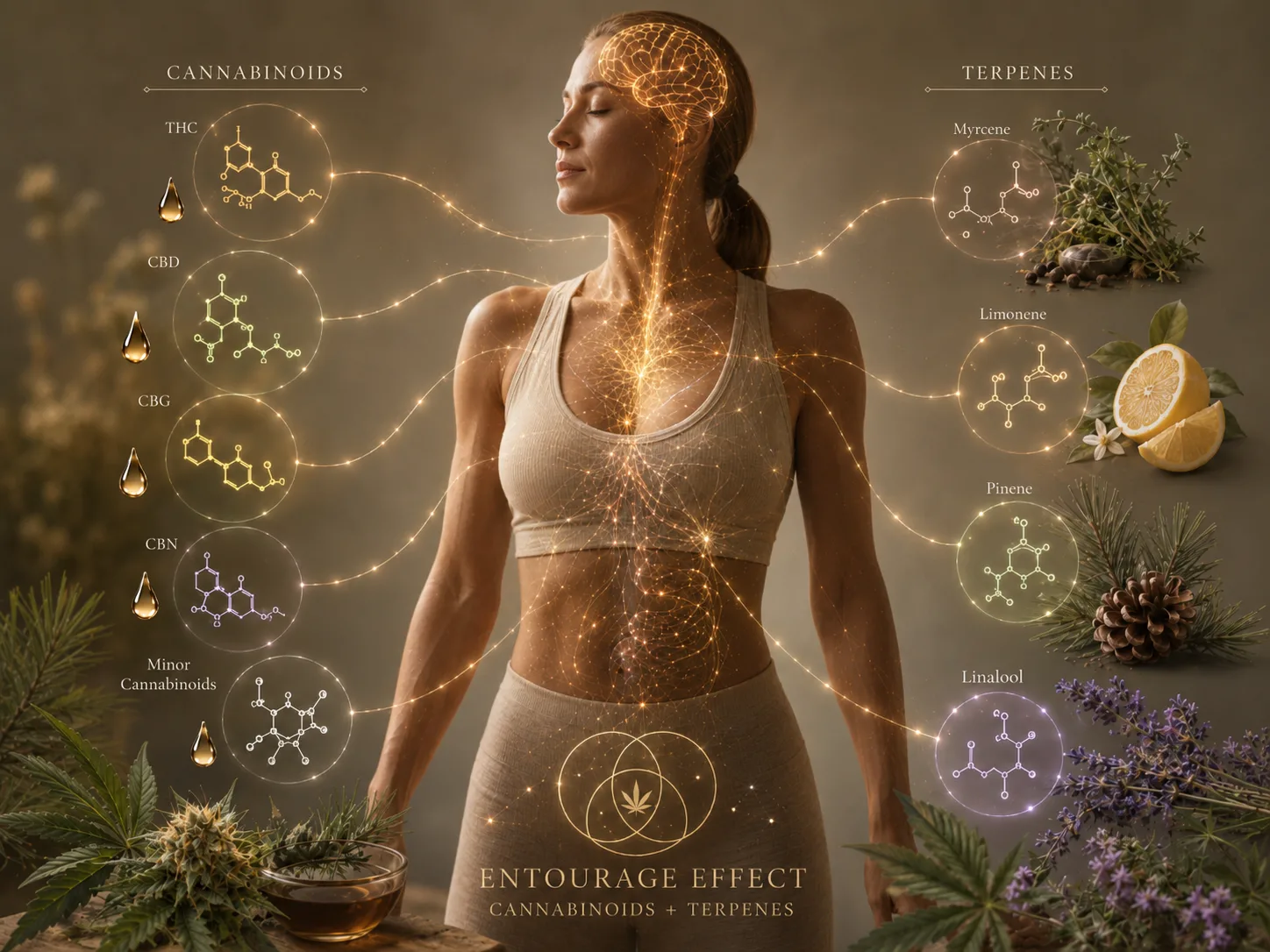
A single cannabis compound in isolation behaves differently than that same compound surrounded by dozens of others. That’s the core finding behind one of the most talked-about concepts in cannabis science. And once you understand it, you’ll look at product labels completely differently.
The entourage effect, which cannabis researchers have been studying for decades, refers to the synergistic interaction between cannabinoids, terpenes, and other plant compounds that occurs in whole-plant cannabis. The theory, and the growing body of research behind it, suggests that these compounds may influence one another’s effects in ways that differ from isolated cannabinoids, although researchers are still determining how significant these interactions are in humans. For consumers choosing between full-spectrum, broad-spectrum, and isolate products, this isn’t just interesting science; it’s a practical framework for making better decisions.
Who Discovered the Entourage Effect?
Israeli researchers first introduced the term Dr. Raphael Mechoulam and Shimon Ben-Shabat in a 1998 paper examining how non-psychoactive compounds in cannabis seemed to enhance the activity of the endocannabinoid system. Mechoulam, often called the “father of cannabis research” for his role in isolating and identifying THC in 1964, observed that endogenous cannabinoids didn’t act alone. They worked alongside a suite of related compounds that appeared to modulate and amplify the primary effects.
British pharmacologist Dr. Ethan Russo expanded significantly on this framework in his landmark 2011 paper, “Taming THC,” published in the British Journal of Pharmacology. Russo laid out specific mechanisms by which terpenes and cannabinoids interact, proposing that compounds like myrcene, limonene, and pinene don’t just contribute aroma; they actively modulate how cannabinoids bind to receptors in the brain and body. That paper became foundational for how the cannabis industry and medical research community think about whole-plant medicine.
What Is the Entourage Effect, Exactly?
At its most basic, the entourage effect cannabis science describes is this: cannabis plants contain hundreds of biologically active compounds, and those compounds influence each other’s behavior when they enter your system together.
The two main categories are cannabinoids and terpenes. Cannabinoids like THC and CBD interact directly with your endocannabinoid system — a network of receptors (CB1 and CB2) spread throughout the brain, nervous system, and immune tissue. THC binds primarily to CB1 receptors, producing psychoactive effects. CBD has a more complex mechanism, interacting with multiple receptor types and modulating how THC behaves.
Terpenes are the aromatic compounds that give each cannabis strain its distinctive smell and flavor. Myrcene (earthy, musky) is the most common in cannabis. Limonene (citrusy) and pinene (piney) are also prevalent. Linalool, the compound that gives lavender its scent, also appears in many cannabis cultivars. For a long time, terpenes were considered mostly cosmetic — responsible for scent and flavor but not much else. The entourage effect research flipped that assumption.
Russo and subsequent researchers proposed that terpenes cross the blood-brain barrier and influence how cannabinoids interact with receptors. Myrcene, for instance, appears to increase cell membrane permeability, potentially allowing cannabinoids to reach the brain more efficiently. Pinene may counteract some of the short-term memory effects associated with THC. Linalool and limonene have both shown anxiolytic (anxiety-reducing) properties in preclinical studies. In other words, the terpene profile of a cannabis product isn’t just about how it smells — it may actively shape how it feels.
Is the Entourage Effect Scientifically Proven?
This is the honest part: preclinical research and clinical observation support the entourage effect, but it hasn’t been definitively proven through large-scale, double-blind human clinical trials the way pharmaceutical drugs are validated. Most of the foundational research has been conducted in animal models or cell studies, with a smaller body of human observational data.
That said, the evidence base is growing. A November 2024 review, “The Entourage Effect in Cannabis Medicinal Products,” examined the current state of research across multiple cannabinoid and terpene interactions. It concluded that while the full mechanistic picture is still being mapped, the synergistic activity between specific cannabis compounds is biologically plausible and consistently observed across multiple laboratory models.
The review highlighted specific cannabinoid combinations—particularly THC and CBD together—as having the most robust evidence for synergistic benefit. However, the authors maintained a cautious tone regarding terpenes, noting that while cannabinoid-terpene synergy shows promise in exploratory studies, it remains unproven in definitive human clinical trials.
One of the clearest real-world data points comes from one clinical trial discussed in the review, which compared Sativex — a standardized THC:CBD extract containing nearly equal amounts of the two cannabinoids —with a THC-predominant extract and placebo in patients with advanced cancer pain. The Sativex group showed greater analgesic benefit than the THC-predominant extract and placebo in that study. However, this was a specific pain trial, not evidence that Sativex consistently outperforms pure THC for pain or that it reduces multiple-sclerosis spasticity more effectively than THC isolate.
Cannabinoids and Terpenes Working Together: A Closer Look
The THC-CBD interaction is the most studied cannabinoid pairing, and it illustrates the entourage effect in practical terms. THC on its own at high doses can increase anxiety in some users — particularly those with lower tolerance or a predisposition to anxiety responses. CBD appears to modulate this by interacting with the same CB1 receptors that THC activates, essentially softening some of the more intense psychoactive effects without eliminating them.
This is why products with a balanced THC:CBD ratio often feel different from high-THC isolate products, even at equivalent THC doses. CBD changes the experience not only by adding its own effects, but also by altering how THC behaves.
Terpenes add another layer of complexity to the cannabis experience. Take two strains with identical THC percentages but different terpene profiles. A myrcene-dominant strain may tend toward more sedating, body-heavy effects for some users. A limonene-dominant strain might lean toward a more uplifting, mentally clear experience. A pinene-forward profile could potentially feel more alert and focused. These are not guaranteed outcomes — individual responses vary, and the research is still evolving. But this interplay, commonly referred to as the entourage effect, is why total THC percentage alone tells only part of the story when choosing a product.
Full Spectrum vs Isolate: What the Entourage Effect Means for Your Purchase
Understanding the entourage effect, cannabis science points toward changes how you evaluate products. The three main categories are:
Full-spectrum products contain the complete range of cannabinoids and terpenes present in the original plant, including THC. Nothing is removed or isolated. These products are most likely to deliver the entourage effect described in the research because they preserve the full complement of interacting compounds.
Broad-spectrum products go through processing to remove THC while retaining other cannabinoids and terpenes. They’re designed for consumers who want the potential benefits of whole-plant synergy without the psychoactive component or without detectable THC for drug testing purposes. The entourage effect may still apply, though it’s a reduced version since the THC-CBD interaction is absent.
Isolate products contain a single extracted compound — usually CBD — with everything else removed. Pure CBD isolate, for example, is 99%+ cannabidiol and nothing else. There’s no entourage effect here by definition, since synergy requires multiple compounds. Isolates aren’t without use — they’re valuable for people who need a highly controlled, consistent dose of one specific compound — but they don’t offer the whole-plant benefit that full-spectrum products do.
For consumers using cannabis for specific wellness goals, the distinction matters. Some research suggests that certain full-spectrum or cannabinoid-rich preparations may provide advantages over isolated compounds in specific research contexts, although results vary by condition and formulation.
Does the Entourage Effect Apply to CBD Products?
Yes, and this is especially relevant for consumers in states where THC access is limited, or for those using CBD specifically for wellness rather than for psychoactive effects.
A 2018 landmark meta-analysis published in Frontiers in Neurology evaluated observational clinical data from multiple pediatric epilepsy studies—including historical data from pioneering Israeli research teams—to compare the effects of CBD-rich extracts against a pure CBD isolate.
The aggregated data, accessible via the National Institutes of Health PMC Portal, showed that CBD-rich full-spectrum extracts produced better seizure reduction at lower doses. Specifically, 71% of patients using full-spectrum extracts reported reduced seizure frequency, compared with only 46% of patients using purified CBD isolates. Furthermore, the full-spectrum extract maintained a more predictable, linear dose-response curve, whereas the isolate required significantly higher doses to produce comparable effects because of its narrower therapeutic window.
This finding—that full-spectrum CBD products perform more efficiently than a pure CBD isolate—is one of the cleanest demonstrations of the entourage effect in human clinical data. It shows that the entourage effect doesn’t require high levels of THC to see synergy; the interaction between CBD and minor cannabinoids (like CBG, CBC, and CBN), along with plant terpenes, is enough to produce meaningful differences in clinical outcomes.
For everyday consumers, this suggests that a high-quality full-spectrum CBD product may offer more therapeutic value than an isolate at the same price point, even if the CBD milligram count is identical.
What Products Give You the Entourage Effect?
Any product made from whole-plant cannabis or a full-spectrum extract has the best chance of delivering the entourage effect. In practical terms, that means:
Whole flower is the most straightforward option — it’s cannabis in its least processed form, with the complete cannabinoid and terpene profile intact. The terpene content in flower is particularly high right after harvest and degrades over time with light and heat exposure, which is why freshness and proper storage matter.
Full-spectrum concentrates — live resin, rosin, and similar solventless or low-heat extracts — preserve terpenes better than distillate-based products, which are processed at temperatures that vaporize most of the terpene content. A live resin cartridge will deliver a more complete entourage effect than a distillate cartridge with terpenes added back in afterward, because the reintroduced terpenes are often a narrow selection rather than the full original profile.
Full-spectrum tinctures and oils retain cannabinoid ratios close to the original plant. Look for products that list their terpene content or describe their extraction method clearly — that transparency is a good indicator that the producer takes whole-plant preservation seriously.
At Garden Club, the focus on vertically integrated sourcing from brands like Eden’s Trees means the product journey from cultivation to shelf is shorter and more controlled — which matters for terpene preservation and overall product integrity.
Reading Labels with the Entourage Effect in Mind
Applying entourage effect cannabis thinking to label reading is practical and worth developing as a habit. A few things to look for:
Total cannabinoid content is more informative than THC percentage alone. A product listing THC, CBD, CBG, and CBN gives you a clearer picture than one that only lists THC.
Terpene profiles, when listed, tell you a lot about the likely character of the experience. Dominant myrcene and linalool suggest a relaxing, body-forward effect. Limonene and terpinolene suggest something more uplifting. Caryophyllene, which interacts directly with CB2 receptors, adds an anti-inflammatory dimension.
Extraction method matters for concentrates and oils. Cold-processed, live, or solventless extractions preserve the most terpene content. Distillates are stripped down and often have terpenes reintroduced—functional, but a different product than a true full-spectrum extract.
The more of the plant that reaches the final product in its natural ratios, the more the entourage effect has a chance to do what the research suggests it does. That’s a simple framework, and it holds up across product categories.
For everyday consumers, this data suggests that a high-quality full-spectrum CBD or cannabis product may offer significantly more therapeutic value than an isolate at the same price point, even if the primary milligram count is identical.
Understanding cannabinoids, terpenes, and extraction methods can help you look beyond THC percentage when comparing cannabis products. Explore the selection at your local Garden Club and review available product information to find options that fit your preferences.
